> ## Documentation Index
> Fetch the complete documentation index at: https://upstash-fix-issues-on-docs.mintlify.site/llms.txt
> Use this file to discover all available pages before exploring further.
# Cloudflare Workers
### Database Setup
Create a Redis database using [Upstash Console](https://console.upstash.com) or
[Upstash CLI](https://github.com/upstash/cli). Select the global to minimize the
latency from all edge locations.
### Project Setup
We will use **C3 (create-cloudflare-cli)** command-line tool to create our application. You can open a new terminal window and run C3 using the prompt below.
```shell npm
npm create cloudflare@latest
```
```shell yarn
yarn create cloudflare@latest
```
This will install the `create-cloudflare` package, and lead you through setup. C3 will also install Wrangler in projects by default, which helps us testing and deploying the application.
```text
➜ npm create cloudflare@latest
Need to install the following packages:
create-cloudflare@2.1.0
Ok to proceed? (y) y
using create-cloudflare version 2.1.0
╭ Create an application with Cloudflare Step 1 of 3
│
├ In which directory do you want to create your application?
│ dir ./cloudflare_starter
│
├ What type of application do you want to create?
│ type "Hello World" Worker
│
├ Do you want to use TypeScript?
│ yes typescript
│
├ Copying files from "hello-world" template
│
├ Do you want to use TypeScript?
│ yes typescript
│
├ Retrieving current workerd compatibility date
│ compatibility date 2023-08-07
│
├ Do you want to use git for version control?
│ yes git
│
╰ Application created
```
We will also install the **Upstash Redis SDK** to connect to Redis.
```bash
npm install @upstash/redis
```
### The Code
Here is a Worker template to configure and test Upstash Redis connection.
```ts src/index.ts
import { Redis } from "@upstash/redis/cloudflare";
export interface Env {
UPSTASH_REDIS_REST_URL: string;
UPSTASH_REDIS_REST_TOKEN: string;
}
export default {
async fetch(
request: Request,
env: Env,
ctx: ExecutionContext
): Promise {
const redis = Redis.fromEnv(env);
const count = await redis.incr("counter");
return new Response(JSON.stringify({ count }));
},
};
```
```js src/index.js
import { Redis } from "@upstash/redis/cloudflare";
export default {
async fetch(request, env, ctx) {
const redis = Redis.fromEnv(env);
const count = await redis.incr("counter");
return new Response(JSON.stringify({ count }));
},
};
```
### Configure Credentials
There are two methods for setting up the credentials for Upstash Redis client. The recommended way is to use Cloudflare Upstash Integration. Alternatively, you can add the credentials manually.
#### Using the Cloudflare Integration
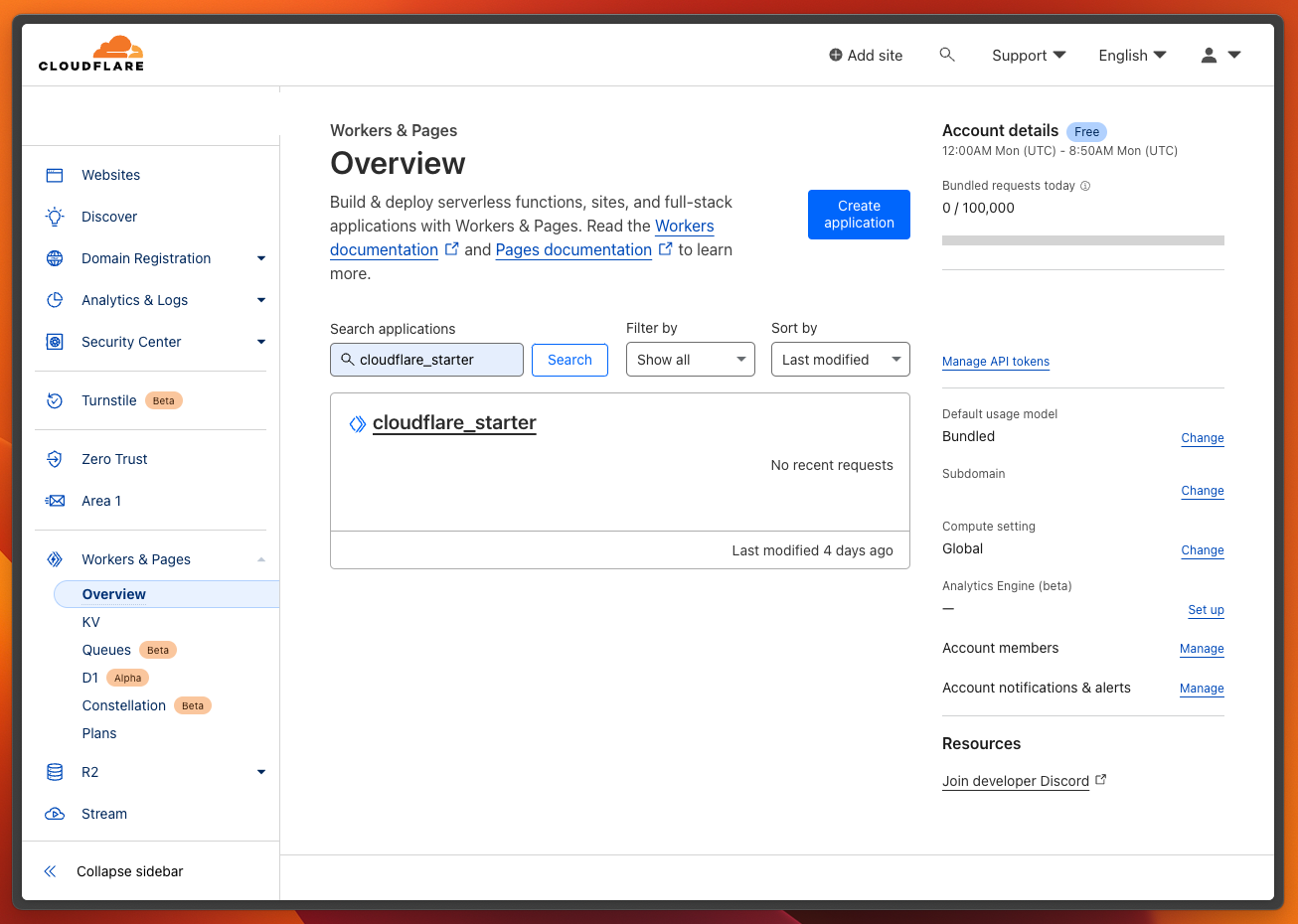
Access to the [Cloudflare Dashboard](https://dash.cloudflare.com) and login with the same account that you've used while setting up the Worker application. Then, navigate to **Workers & Pages > Overview** section on the sidebar. Here, you'll find your application listed.
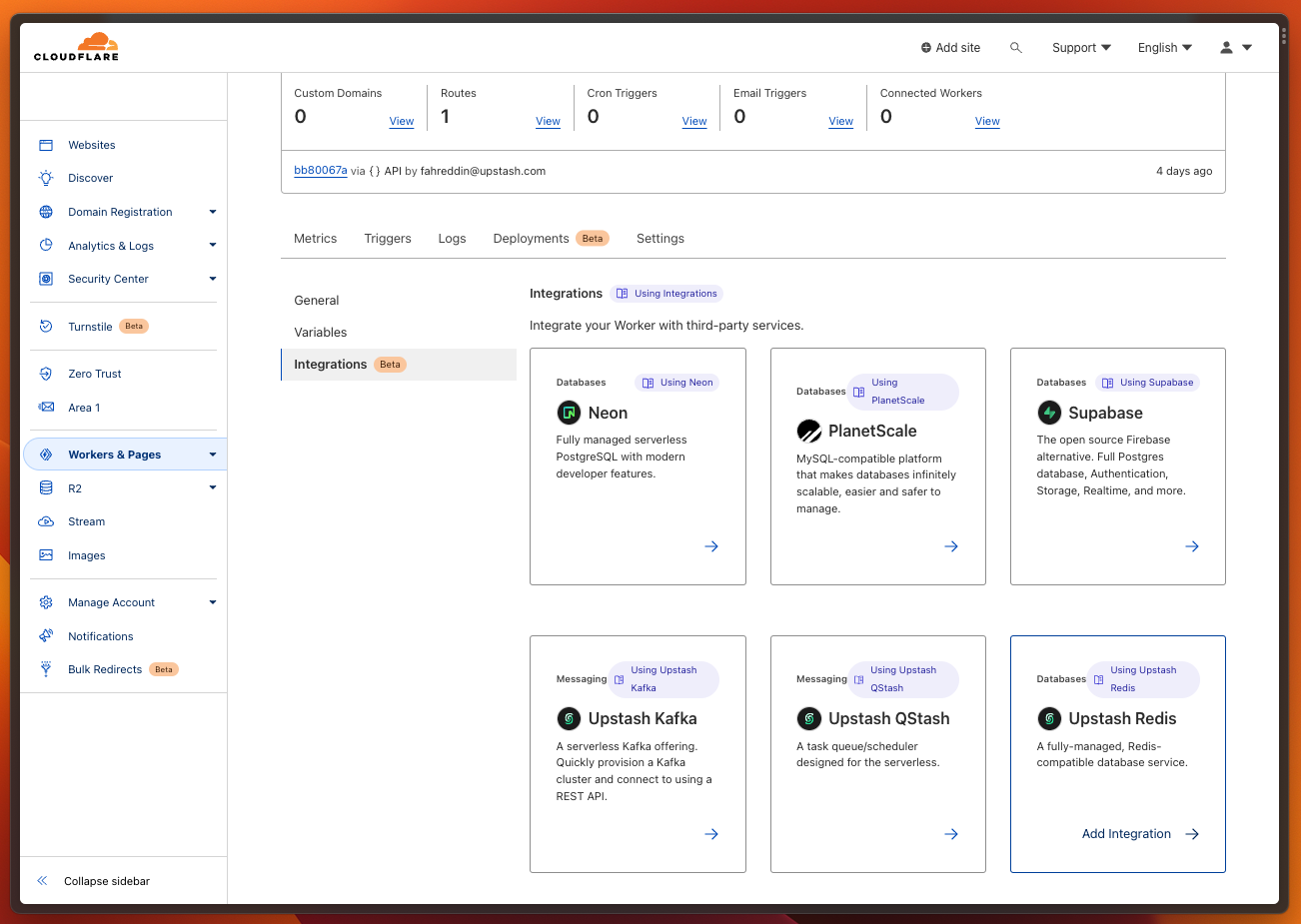
 Clicking on the application will direct you to the application details page, where you can perform the integration process. Switch to the **Settings** tab in the application details, and proceed to **Integrations** section. You will see various Worker integrations listed. To proceed, click the **Add Integration** button associated with the Upstash Redis.
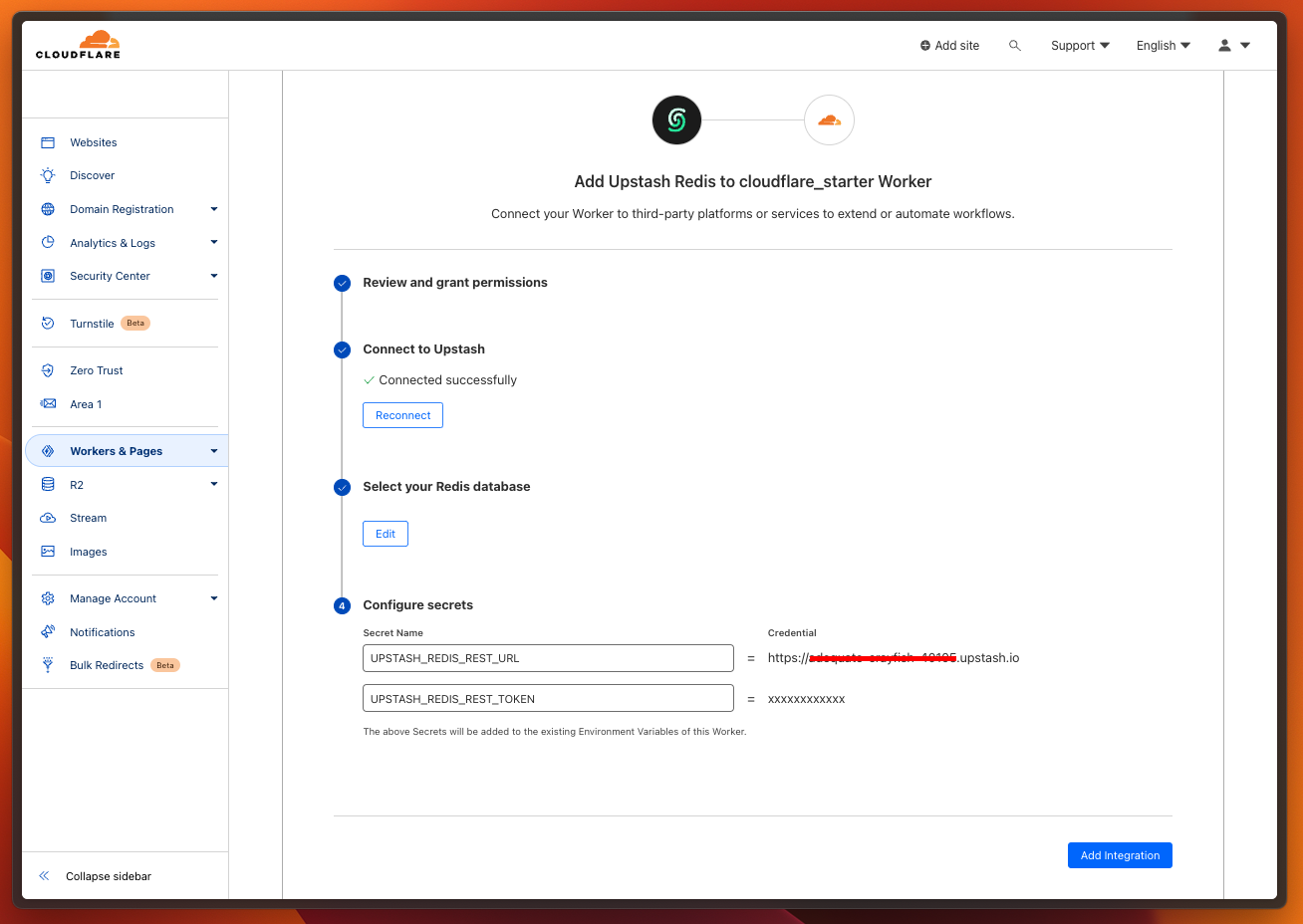
 On the Integration page, connect to your Upstash account. Then, select the related database from the dropdown menu. Finalize the process by pressing Save button.
Please don't make any changes in the secret names on the **Configure secrets**
step. These credentials will be automatically picked up by
`Redis.fromEnv(env)` line in the code as `UPSTASH_REDIS_REST_URL` and
`UPSTASH_REDIS_REST_TOKEN`.
On the Integration page, connect to your Upstash account. Then, select the related database from the dropdown menu. Finalize the process by pressing Save button.
Please don't make any changes in the secret names on the **Configure secrets**
step. These credentials will be automatically picked up by
`Redis.fromEnv(env)` line in the code as `UPSTASH_REDIS_REST_URL` and
`UPSTASH_REDIS_REST_TOKEN`.
 #### Setting up Manually
Navigate to [Upstash Console](https://console.upstash.com) and copy/paste your `UPSTASH_REDIS_REST_URL` and `UPSTASH_REDIS_REST_TOKEN` to your `wrangler.toml` as below.
```yaml
[vars]
UPSTASH_REDIS_REST_URL="REPLACE_HERE"
UPSTASH_REDIS_REST_TOKEN="REPLACE_HERE"
```
### Test and Deploy
You can test the function locally with `npx wrangler dev`
Deploy your function to Cloudflare with `npx wrangler deploy`
The endpoint of the function will be provided to you, once the deployment is done.
### Repo
Javascript:
[https://github.com/upstash/upstash-redis/tree/main/examples/cloudflare-workers](https://github.com/upstash/upstash-redis/tree/main/examples/cloudflare-workers)
Typescript:
[https://github.com/upstash/upstash-redis/tree/main/examples/cloudflare-workers-with-typescript](https://github.com/upstash/upstash-redis/tree/main/examples/cloudflare-workers-with-typescript)
Wrangler 1:
[https://github.com/upstash/upstash-redis/tree/main/examples/cloudflare-workers-with-wrangler-1](https://github.com/upstash/upstash-redis/tree/main/examples/cloudflare-workers-with-wrangler-1)
#### Setting up Manually
Navigate to [Upstash Console](https://console.upstash.com) and copy/paste your `UPSTASH_REDIS_REST_URL` and `UPSTASH_REDIS_REST_TOKEN` to your `wrangler.toml` as below.
```yaml
[vars]
UPSTASH_REDIS_REST_URL="REPLACE_HERE"
UPSTASH_REDIS_REST_TOKEN="REPLACE_HERE"
```
### Test and Deploy
You can test the function locally with `npx wrangler dev`
Deploy your function to Cloudflare with `npx wrangler deploy`
The endpoint of the function will be provided to you, once the deployment is done.
### Repo
Javascript:
[https://github.com/upstash/upstash-redis/tree/main/examples/cloudflare-workers](https://github.com/upstash/upstash-redis/tree/main/examples/cloudflare-workers)
Typescript:
[https://github.com/upstash/upstash-redis/tree/main/examples/cloudflare-workers-with-typescript](https://github.com/upstash/upstash-redis/tree/main/examples/cloudflare-workers-with-typescript)
Wrangler 1:
[https://github.com/upstash/upstash-redis/tree/main/examples/cloudflare-workers-with-wrangler-1](https://github.com/upstash/upstash-redis/tree/main/examples/cloudflare-workers-with-wrangler-1)